
QR codes on graves
How the code works, what a scan opens, and why it is not a headstone.
Graves and QR
The short version: it depends on the burial ground, and you must ask them first. This page is about permission rather than product — who decides, how grounds differ, what to ask before ordering, and what to do if the answer is no.
Some do and some do not — there is no single rule. Each cemetery, burial ground, local authority or operator sets its own memorial regulations about what may be attached to a grave or headstone, and those rules differ from one ground to the next. Contact the cemetery or burial authority responsible for the grave before buying or fitting anything.
That is an unsatisfying answer, and it is the accurate one. Anybody telling you QR plaques are simply allowed is describing their sales process, not your cemetery's regulations.
The body that manages the burial ground. That may be a local authority, a private cemetery operator, a religious trust or a parish, and each publishes its own regulations covering memorials and what may be added to them.
In practice the person to speak to is the cemetery office or burial ground manager. Ask for the written memorial regulations rather than relying on a verbal yes — the person who fits the plaque and the person who inspects the grave are often not the same.
We are not going to summarise this as a legal position. Arrangements differ by ground, by operator and by the terms of the burial itself, and a general statement about rights over a grave would be wrong somewhere. Get the rules for the specific ground in writing.
There is no single answer. Local authority cemeteries each publish their own memorial regulations, and they are not standardised across the UK — some permit additions to an existing headstone subject to approval, others restrict what may be fixed, and others do not address QR plaques at all.
Where regulations predate this kind of product, the request will usually be assessed under whatever the ground already says about attachments and additional memorials. That makes a written application worth more than an informal enquiry.
The same principle applies: the ground sets its own rules, and they must be checked individually. Private operators and religious burial grounds are not bound by another cemetery's policy, and some maintain a deliberately uniform appearance across the site.
For Muslim burial grounds there can be two separate considerations — the ground's own regulations, and the family's religious view of what belongs at a grave. Those are different questions with different people to ask; the first belongs to the burial ground, the second to a qualified scholar the family trusts. Muslim grave markers in the UK.
Treat this as a question to confirm with the burial authority rather than an assumption. Many grounds will only accept an application from a specific named person connected to the grave, and will say who that is when asked.
It matters most where a grave holds more than one burial or where the family has dispersed since. Settling who applies at the start avoids a plaque being removed later over a disagreement nobody anticipated. We are not stating what rights a grave owner has in law — ask the burial authority, and take independent advice if the answer is contested.
One call usually covers all of these. Keep the reply in writing.
Then no plaque goes on the grave. There is no workaround worth having — an unauthorised fitting can be removed without notice, and the family loses both the plaque and the goodwill of the people who look after the ground.
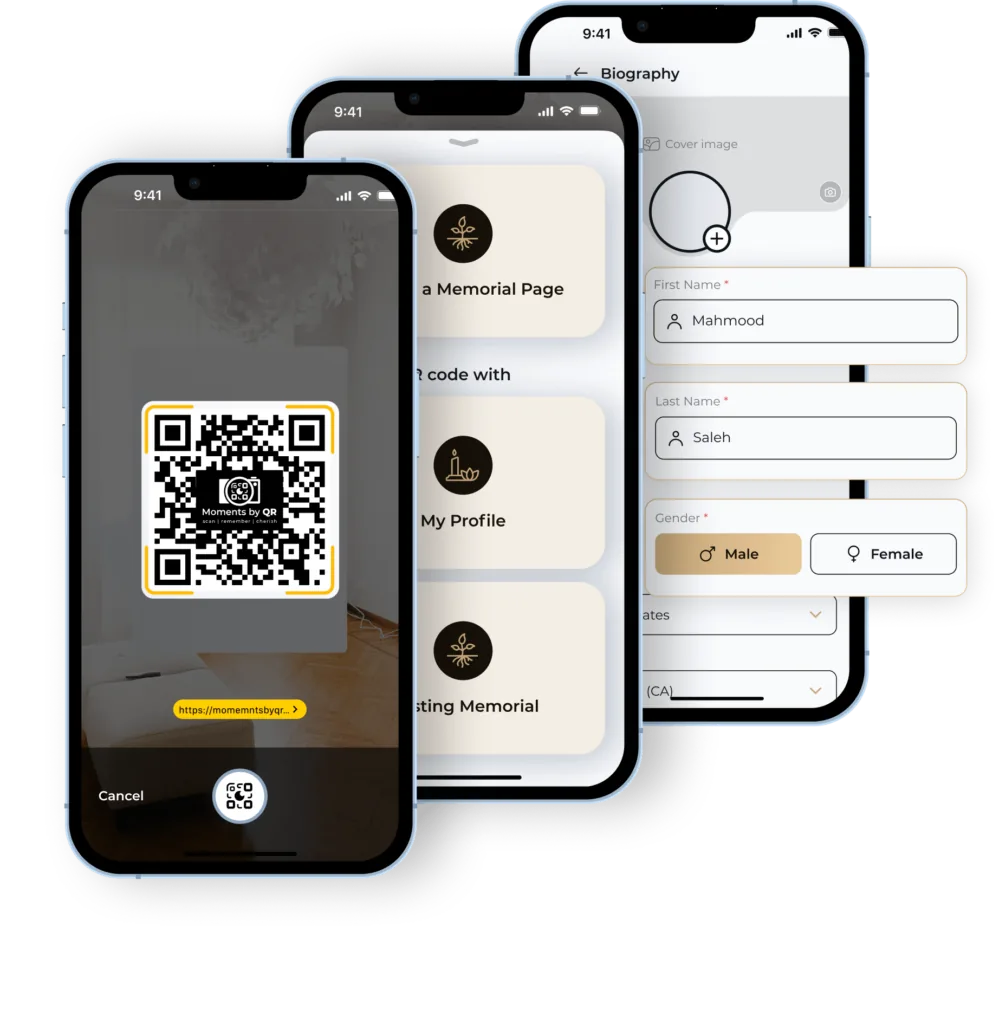
The memorial is the substantive part. A Memorial Page is shared by link, in a family group, or on a printed order of service — no physical fitting involved.
Some grounds permit additions in a specific form or position even when a general one is refused. Ask what would be acceptable rather than only whether your first idea is.
The Grave Location section of a memorial holds the burial ground and plot details, so relatives who have never visited can still find it.
Where a headstone is being installed, replaced or re-lettered, permission is usually being sought anyway. That is the natural point to ask.
The plaque is optional and always subject to the burial ground. The Memorial Page — the life story, the photographs, the grave details — is yours to create either way.
Nothing on this page is legal advice or a statement of any cemetery's rules. Always confirm with the burial authority responsible for the grave.
Moments by QR states product facts about its own service from first-party product information, cites official primary sources for anything statutory or operational, and leaves questions it cannot evidence visibly unanswered rather than guessing.
How the code works, what a scan opens, and why it is not a headstone.
The hub: recording a resting place and connecting it to a story.
The plaque, the memorial behind it and the privacy settings.