
Religious questions — your own scholar
Timing, washing, shrouding, prayer, what may be placed on a grave. Recognised views differ. We do not answer these here.
Support and signposting
This page does not arrange burials, sell funeral services or issue religious rulings. It exists to do one thing: help a family in the first confused hours work out which question belongs to whom — the burial ground, the registrar, the funeral director or a scholar — and point at the source that can actually answer it.
Two processes run at once and are often confused. One is statutory — the death has to be registered, and where a coroner is involved the body has to be released before a burial can take place. The other is arrangement — a funeral director and a burial ground have to be secured. Neither is religious, and neither is decided by us.
In England and Wales the official sequence, as published by GOV.UK, is: the doctor confirms the death and contacts the medical examiner; the medical examiner’s office reviews the cause of death and then confirms to you that the death can be registered; you register within 5 days of that confirmation (8 days in Scotland), including weekends and bank holidays; and registration produces a certificate for burial or cremation, which must be given to the funeral director, crematorium or burial authority before the funeral can take place. Where a coroner is involved, the documents can differ and the coroner releases the body once their examinations are complete.
That is the shape of it, and it is as far as we will go. Check the position for your own nation and circumstances on GOV.UK, which is the source for the paragraph above and is kept current in a way a third-party page is not.
What we are still not publishing, and why. We hold no verified source for how long a coroner takes to release a body, for out-of-hours or expedited release practice, for the Northern Ireland procedure, or for any list of Muslim burial grounds and their fees. Rather than write something plausible, those remain recorded as open gaps until a primary source is checked.Open source gaps recorded for this page: 3.
Most of the distress families describe in the first days comes from asking the right question to the wrong party. These three sit separately and cannot answer for each other.
Timing, washing, shrouding, prayer, what may be placed on a grave. Recognised views differ. We do not answer these here.
Availability, fees, plot rules, what may be fitted to a grave, visiting arrangements. Only the burial authority can answer for its own ground.
Registering the death and releasing the body are statutory processes run by the state, not by a mosque or a funeral director.
They coordinate between the family, the burial ground and the statutory process. Ask directly what they do and do not handle.
Availability, cost and rules differ by ground and change over time. Ask the ground itself rather than relying on a third-party summary.
Death registration, and where a coroner is involved, release of the body. Procedure and timescales differ across England, Wales, Scotland and Northern Ireland — use the official guidance for your nation.
Do not take a ruling from a commercial website, including this one.
Ground, section, plot reference, date, who was present. This is the detail families most often cannot recover years later.
Ask the ground itself, in writing where you can, and keep the answer. Cemetery rules are local, they change, and a rule quoted by a supplier or a forum is not binding on the ground your family will actually use.
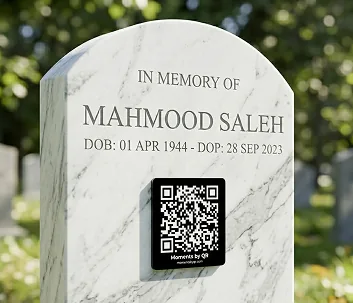
If your question is specifically about fitting something to the grave later — a marker, a plaque or a scannable code — the permission question is set out separately in cemetery permission for a grave QR code, and the marker question in Islamic headstones and Muslim grave markers.
Burial timing, ghusl and shrouding, who prays, what is said, what may be written on a marker, and what benefits the deceased are religious questions. Recognised scholarly views differ on several of them.
Moments by QR does not answer religious questions. No Qur’an, Hadith, du’a, ruling or permissibility statement appears on this page, and none will be added until an appropriately qualified reviewer has signed it off. Please put these questions to a scholar your own family trusts, and the practical questions to the burial ground.Internal review status: Religious review required.
The burial details and the person's own history. Ground, section and plot reference; the date; who attended; and the names, places and dates that only the eldest relatives still carry. This is the part nobody is responsible for, and the part that quietly disappears.
That is the only part of this subject Moments by QR is involved in. If you want the practical method rather than the product, preserving memories after a death sets it out step by step.
Nothing on this page is a sales argument. When the arrangements are behind you and the family wants somewhere to keep the record, that is where we come in — and not before.

Moments by QR states product facts about its own service from first-party product information, cites official primary sources for anything statutory or operational, and leaves questions it cannot evidence visibly unanswered rather than guessing.
An unaffiliated orientation page for a named Muslim burial ground.
Who decides what may be fitted to a grave, and how to ask.
What families keep after the burial, and the words people use.