
Observed practice
What is commonly seen in Muslim sections of UK cemeteries. Describes what families do, and carries no religious weight of its own.
Graves and QR
Three different questions get mixed together whenever this is searched: what families actually do, what a cemetery permits, and what Islam guides. They have different answers and different people to ask, so this page keeps them apart — and leaves the religious question to those qualified to answer it.
It is a general term for a grave marker used at a Muslim burial, rather than a defined type of product. In UK cemeteries the phrase is used for anything from a plain ground-level marker to a modest upright stone, and what is appropriate is a matter of religious guidance and cemetery regulation rather than product description.
Because the term is loose, monumental masons, cemetery offices and families do not always mean the same thing by it. It is worth being specific about what you are asking for whenever you use the phrase.
Most confusion in this topic comes from answering one of these with another.
What is commonly seen in Muslim sections of UK cemeteries. Describes what families do, and carries no religious weight of its own.
What the burial ground permits: size, materials, inscriptions, additions. Set by the operator or trust, and differs from ground to ground.
Whether something is permitted or advisable in Islam. This belongs to qualified scholars, and views differ between schools and communities.
This is a religious question about permissibility, and recognised scholarly views on grave markers are not uniform. Separately from that, whatever a family decides still has to fit the rules of the burial ground.
This question needs a scholar, not a memorial company. Permissibility is a religious matter on which recognised views differ, and Moments by QR is not qualified to answer it. This section is held for review by an appropriately qualified reviewer and will not carry an answer until then. Please put the question to a scholar your family trusts, and the practical question to the burial ground separately.Internal review status: Religious review required.
Where markers are used in UK Muslim burial sections, they are typically restrained: a name, dates, sometimes a short line or a supplication. Elaborate portraiture and long biographical inscriptions are far less commonly seen than in other sections of the same cemeteries.
That is a description of what is observed, not a statement of what is required. Whether a particular inscription is appropriate is a religious question for a scholar, and whether it is permitted is a question for the burial ground. Practice also varies between communities and countries of origin within the same UK cemetery.
There are two separate layers. The burial ground publishes memorial regulations covering size, material, foundations and what may be added — and these differ between grounds. Alongside that, families may follow religious guidance on restraint. Neither layer can be generalised across the UK.
Some Muslim burial grounds also keep a deliberately uniform appearance across the whole section, which can restrict choices further than a general cemetery would. Ask for the regulations in writing before commissioning anything — how cemetery permission works.
Work in this order: confirm the burial ground's regulations, settle the religious question with a scholar your family trusts, then approach a mason — not the other way round.
Doing it in that order avoids the common outcome of a family commissioning something that either the ground will not permit or the family later feels uneasy about. Masons who work regularly with a particular cemetery will usually know its regulations, but the regulations themselves should still come from the cemetery office.
There are three parts to this, and only two of them have answers we can give.
This question needs a scholar, not a memorial company. Permissibility is a religious matter on which recognised views differ, and Moments by QR is not qualified to answer it. This section is held for review by an appropriately qualified reviewer and will not carry an answer until then. Please put the question to a scholar your family trusts, and the practical question to the burial ground separately.Internal review status: Religious review required.
Worth noting either way: a memorial does not require a plaque at all. Families who prefer the grave to remain exactly as it is can keep the memorial entirely digital.
Where a marker is plain by choice, the life behind it is usually held only in what relatives remember and repeat. Writing it down is a separate act from marking the grave.
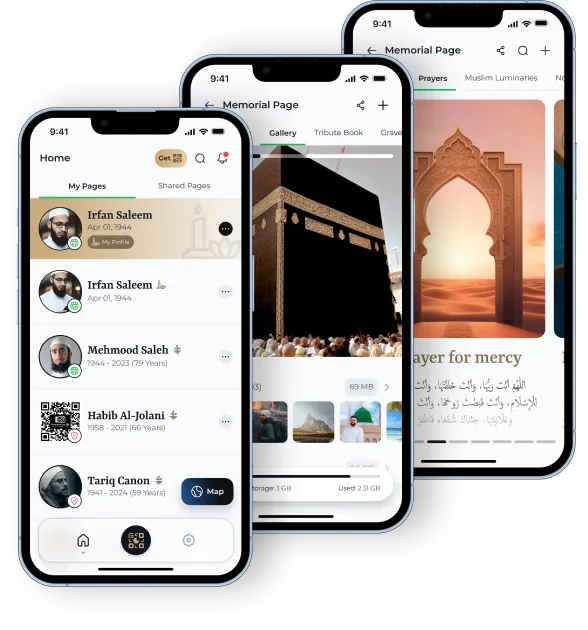
A Memorial Page holds the biography, photographs, family tree and grave details in one place, with the family choosing who can see it — what that looks like for Muslim families, and how the optional QR memorial works.
Some families also consider a small QR plaque, which visitors can scan with a phone to open a digital memorial — how a QR code on a grave works. Whether to add one, and whether the burial ground permits it, are separate decisions.
A memorial can be created with no physical marker and no plaque involved — the grave stays exactly as the family wishes it.
This page does not offer religious guidance. Questions of permissibility should be put to a qualified scholar, and cemetery questions to the burial authority.
Moments by QR states product facts about its own service from first-party product information, cites official primary sources for anything statutory or operational, and leaves questions it cannot evidence visibly unanswered rather than guessing.
Who decides what may be placed on a grave, and what to ask.
Plain graves, dispersed families, and what a written record does.
How they work, and why they are not a headstone substitute.